

There’s an old line in tech sales: “Nobody ever got fired for buying IBM.” It wasn’t a slogan IBM ran. It was what buyers told each other. And it explains B2B buying better than any marketing textbook.
B2B buyers aren’t just asking “is this good?” They’re asking “if I pick this and it goes wrong, will it be my fault?” Choosing the big safe name protected them. Choosing the small unknown company felt like a risk to their job.
If you’re not IBM, the best tool you have to fight that fear is the customer case study. A good one says, “Companies like yours chose us, and here’s what happened.” A bad one says, “We’re very proud of our innovative partnership.” Guess which one most companies write.
Why case studies matter so much in B2B
B2B purchases are usually made by a group, not one person. Gartner says a typical buying group has six to ten decision makers, and they do most of their research on their own, without talking to you. Your case study is often the thing that gets forwarded around that group. It needs to make the case without you in the room.
That means it has to do three jobs:
- Show the reader someone like them had the same problem.
- Show what changed, with proof.
- Make them feel safe recommending you to their boss.
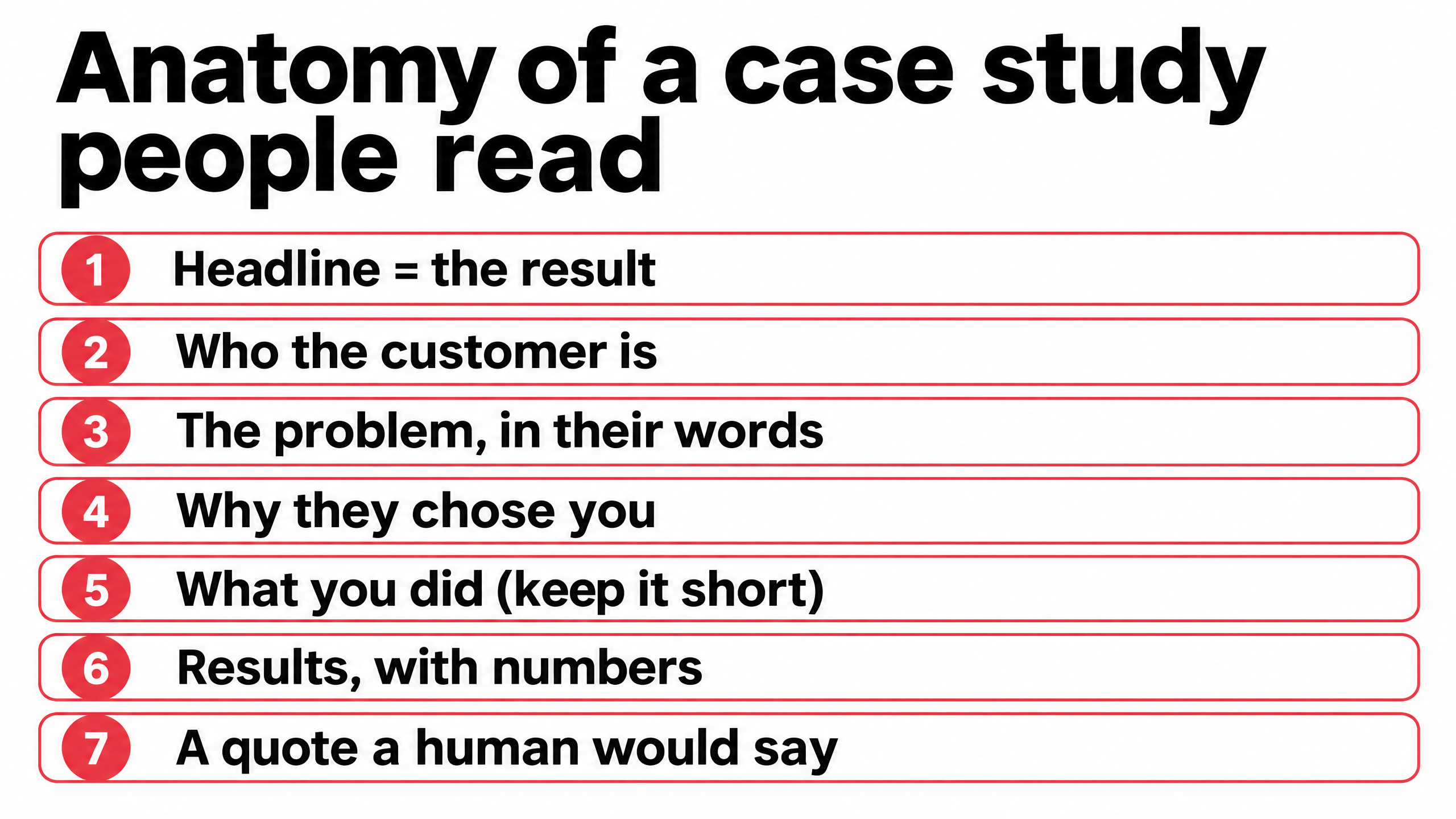
A simple structure that works
1. The headline is the result
Not “Acme Corp and Widgets Inc: A Partnership for Success.” Instead: “How a 40-person food manufacturer cut downtime by 30% in six months.” Lead with the outcome a reader wants. Many people will only read the headline, so make it count.
2. Who the customer is (two sentences)
Industry, size, and what they do. Just enough for the reader to think “that’s like us.”
3. The problem, in their words
This is the most important section and the one most companies rush. What was going wrong? What was it costing them in money, time or stress? What had they already tried? Use direct quotes. “We were spending every Friday afternoon reconciling spreadsheets” is far more powerful than “the client faced data-management challenges.”
4. Why they chose you
What alternatives did they look at, and why did you win? This section does more selling than anything else, because it answers the reader’s own comparison. Be honest. If you won because you were cheaper and faster to set up, say so.
5. What you actually did
Keep it short. Readers care about the outcome more than the process. A few bullet points on what happened and how long it took is plenty.
6. The results, with numbers
Real, specific, attributable numbers: hours saved, revenue gained, costs cut, time to payback. If you don’t have hard numbers, use concrete before-and-after descriptions. “We used to close the books in 12 days. Now it’s 3.”
7. A quote someone would actually say
Not “We are delighted with our partnership with Widgets Inc.” Nobody talks like that. Get the quote from the interview, not from your marketing team. The best ones are slightly informal and a little emotional: “Honestly, I stopped dreading month-end.”
The interview questions to ask your customer
Book 30 minutes with the person who felt the pain the most (not necessarily the person who signed the contract). Ask:
- What was happening before you started looking for help? What made it urgent?
- What else did you consider? Why didn’t you go with them?
- Was there anything that made you nervous about choosing us?
- What’s different now? Can you put a number on it?
- What would you tell a peer who was thinking about working with us?
Question 3 is gold. The fears your customer had are the same fears your next prospect has. Answer them in the case study.
“But our competitors will steal it”
Here’s the objection that kills more case studies than anything else. Someone in senior leadership or sales reads the draft and says, “We can’t publish this. It explains exactly what makes us different. The competition will copy it.”
I get the instinct. But in almost every case, it’s the wrong call. Here’s why.
Your competitors already know more than you think
They talk to the same prospects you do. They hire people who used to work for you. They sit across from your customers at the same trade shows. If what makes you special can be stolen from a two-page case study, it was never much of a secret.
What makes you different is hard to copy, even when it’s written down
Toyota is the classic example. For decades, the Toyota Production System was studied, written about and taught in business schools all over the world. Toyota even ran a joint factory with General Motors in California, called NUMMI, starting in 1984, where GM could see the system up close. Competitors had the playbook for years and still struggled to match Toyota, because the real advantage was the culture, the people and the thousands of small habits behind the system. Not the description of it.
Your business is the same. A case study can say “we cut their downtime by 30% with a weekly maintenance review.” It can’t hand over your team’s experience, your relationships or the judgment that makes the review actually work.
Hiding your best work is the bigger risk
If you don’t tell buyers what makes you special, they’ll assume you’re the same as everyone else, and they’ll pick on price or pick the big safe name. The cost of staying quiet is every deal you never knew you lost.
Share the outcome, not the recipe
If there’s something genuinely proprietary, like a pricing model, a process you’re patenting or a piece of software, you don’t have to publish the details. Describe the problem, the result and why the customer chose you. Leave out the step-by-step. That gives buyers the proof they need without giving anything real away.
Show this section to the next person who says “they’ll steal it.”
Get the customer’s permission first. Always.
This one isn’t optional. Many B2B projects involve confidential information: the customer’s costs, their suppliers, their systems, their problems. Some are covered by a non-disclosure agreement. Publishing without permission can damage the relationship, or worse, break a contract.
- Get written approval. An email from someone with the authority to say yes is the minimum. Many larger companies will need their marketing, PR or legal team to sign off.
- “Anonymous” still needs consent. Leaving out the customer’s name doesn’t make the story anonymous. “A 40-person food manufacturer in the Fraser Valley that switched suppliers last spring” can identify a company to everyone in its industry. Ask before you publish, even if you leave the name out.
- Check your contract. Some agreements say you can’t name the customer, mention the project or use their logo at all. Look before you write.
- Let them review the final version. Agree on the numbers and the quotes together. Customers are much happier to say yes when they know they’ll see it first.
- Make it easy to say yes. Offer to write it for them, keep it short and send it with a deadline. Most customers are glad to help when you do the work.
A case study is a favour from your customer. Treat it like one, and they’ll be happy to do it again.
Mistakes that make case studies unreadable
- It’s all about you. If your company name appears more often than the customer’s, rewrite it.
- Jargon. “Leveraged a best-in-class omnichannel framework.” Your customer didn’t say that. Nobody did.
- No numbers. “Significant improvement” means nothing.
- Too long. Aim for 500 to 800 words. Add a one-paragraph summary at the top for skimmers.
- Buried on the website. Link case studies from the pages buyers actually visit: pricing, product pages and your sales emails.
Formats beyond the PDF
The same story can work as a two-minute customer video, a slide in the sales deck, a LinkedIn post from the customer’s own account, or a short paragraph in your newsletter. Write it once, use it everywhere. Even a single strong case study can do the work of a dozen ads, as Dollar Shave Club showed with one cheap, honest video.
The bottom line
You’re not IBM. You don’t get the “nobody got fired” protection for free. So earn it, one customer story at a time. Make the customer the hero, tell the truth about the problem, show real results, and let a buyer’s peers do the selling for you.
Your logo can sit at the bottom of the page. Your customer’s result goes at the top.
