
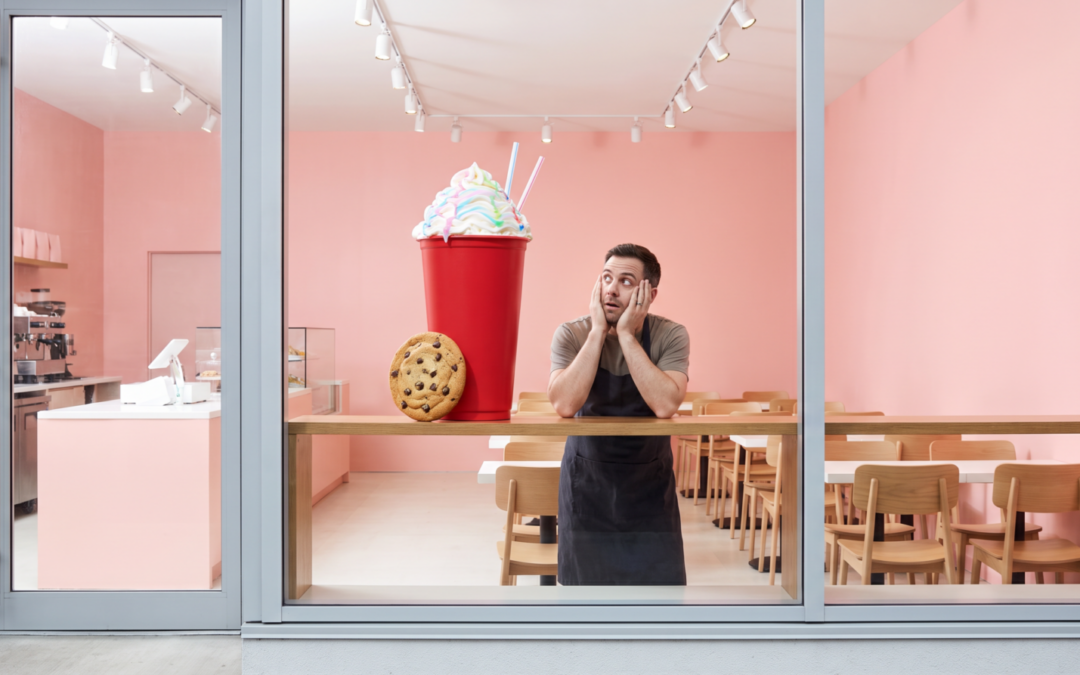
Three years ago you couldn’t scroll TikTok without seeing a pink box. People lined up around the block for a cookie that changed every week. Crumbl went from one shop in Logan, Utah, in 2017 to roughly $1 billion in sales and more than 1,000 stores.
Now the lines are gone. In October 2026 the CEO stood up and said it out loud: “The buck stops with me. It’s my fault where we are today.”
So what happened? And why should a B2B company that has never baked anything care? Grab a cookie (any brand, we’re not picky) and let’s go.
How bad is the Crumbl decline?
Bad. Here are the numbers that have come out this year:
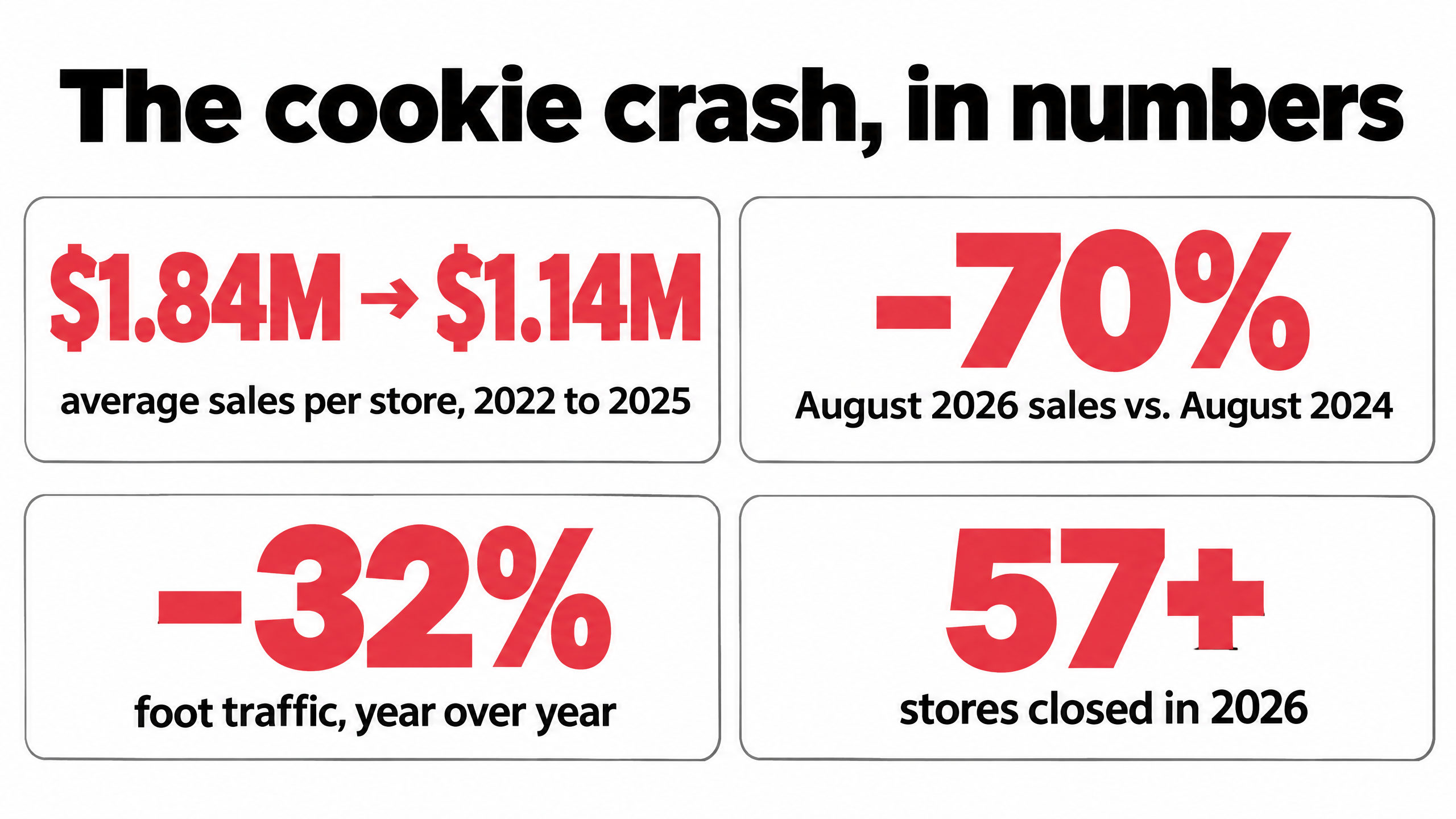
- Sales per store have nearly halved. The average Crumbl did about $1.84 million a year at its 2022 peak. By 2025 it was about $1.14 million, according to Restaurant Business.
- August 2026 sales were 70% below August 2024, per an internal company document. September was about 50% down.
- Foot traffic is down 32% year over year (Placer.ai).
- The typical store made $1,832 in profit a month. That’s not a business. That’s a hobby with a lease.
- At least 57 stores closed in 2026, according to Yahoo Finance, and around 55 more were listed for sale. One Kentucky franchisee filed for Chapter 7 bankruptcy in October.
That’s a cookie crash, not a cookie dip.
Why is Crumbl failing? Four reasons
1. The thing people loved was the novelty, and novelty wears off
Crumbl’s whole model was “new flavours every week, post it, come back next week.” That works brilliantly when it’s new. Then it’s the 150th week and your customers have tried the cookie-butter-lava-cheesecake-whatever and moved on. Hype gets you a first visit. It doesn’t get you a habit.
2. The price crept up and the value didn’t
A single cookie for around five bucks felt like a fun treat in 2021. In a year where people are checking the price of eggs, it feels like a bad decision. Crumbl’s answer this fall was a $1.99 bundle and a 99-cent value menu. When a premium brand starts talking about 99 cents, that’s a sign the premium part has stopped working.
3. Customers changed, and the product didn’t
GLP-1 drugs like Ozempic are changing what people eat. A PwC survey found 61% of users buy fewer sweets. Crumbl sells a cookie that’s basically a dessert for four. That’s a customer shift you can’t fix with a new flavour of the week.
4. They answered with a 32-ounce soda
This is the part that made headlines. In July 2025 Crumbl launched “dirty soda,” big sweet drinks loaded with syrup and cream. It was supposed to lift sales by 20%. Instead, its August 2026 “Soda Week” was the weakest week the company had ever recorded, as TheStreet reported. One 32-oz drink had 130 grams of sugar.
Read that again. Customers were eating fewer sweets, so Crumbl gave them a bigger sweet. That’s not a strategy. That’s a company talking to itself.
Bonus reason: too many stores, too fast
More than 1,000 locations meant more stores fighting over the same shrinking number of cookie fans, often a few miles apart. The franchisees paid for that growth. The founders said in May 2026 that they would step back from running the company.
What B2B companies should learn from the Crumbl crash
You don’t sell cookies. Doesn’t matter. Every one of these mistakes shows up in B2B, usually with a bigger price tag.
Buzz is not the same as value
Crumbl was a marketing machine. Pink boxes, viral videos, the weekly reveal. None of that stopped the slide once people stopped feeling the cookie was worth it. In B2B, the version of this is the slick launch, the award-winning booth, the shiny new brand. All fine. But if your customer can’t say what they get for the money, the buzz fades and the renewals go with it. (We said the same thing about rebrands.)
When customers change, ask them before you launch something
The dirty soda launch looks like a decision made in a boardroom about what the company wanted to sell, not what customers wanted to buy. Before you launch the new product line or add-on, talk to the people who’d actually pay for it. Real customers, not your friends and not your own sales team.
Discounting is a symptom, not a fix
When the value story breaks, the first move is almost always a discount. A 99-cent menu, a “limited time” 30% off, a free extra seat. It might move a quarter. It also tells every customer that the old price was too high. Fix the value story first. If you can’t explain why you’re worth it, start with your value proposition.
Growth you can’t support is just future closures
Crumbl grew its store count faster than its demand. B2B companies do the same with new markets, new verticals and new sales hires. Expansion should follow proof that customers want more of you, not a hope that they will.
Own the mistake, out loud
Credit where it’s due: “It’s my fault” is a rare thing for a CEO to say. Customers and partners forgive a lot when you’re honest about what went wrong and what you’re doing about it. They don’t forgive spin.
The bottom line
Crumbl didn’t fail because of its logo, its pink boxes or its TikTok game. Those were great. It’s struggling because the thing customers paid for stopped being worth the price to them, and the company’s answer was more of what it wanted to sell.
Nobody gives a f* about how famous your brand got. They care whether you’re still worth it today. Ask yourself that question before your customers ask it for you.
