

“Sex sells.” That isn’t news to anyone. It’s one of the oldest rules in advertising, right up there with “put a puppy in it.” Burgers, beer, cars and perfume have leaned on it for decades. So have you ever considered using it in your branding or a campaign? Before you do, it’s worth asking a simple question: does it actually work?
The short answer is: not nearly as well as everyone assumes. And in B2B, it can actively work against you.
What the research says
In 2015, two Ohio State researchers, Robert Lull and Brad Bushman, pulled together the results of 53 separate experiments on sexual and violent content in advertising. Their conclusion surprised a lot of marketers: sexy content didn’t make people remember brands better, and it didn’t make them more likely to buy. In some cases it made things worse, because people remembered the sexy part and forgot whose ad it was.
That’s the problem in a nutshell. Racy creative gets the double-take. It just doesn’t reliably get the sale. If someone remembers your ad but not your name, you paid for someone else’s attention.
Even the brands famous for it walked away
Carl’s Jr. spent years running racy burger commercials featuring models. In 2017 the chain dropped the approach and went back to talking about the food. The old ads had certainly gotten attention, but sales had been flagging, and the new campaign’s message was simple: talk about the burgers.
Victoria’s Secret is an even bigger example. It built an empire on one very specific idea of sexy, then watched shoppers walk away as tastes changed. The brand scrapped its famous fashion show after 2018 and spent the next several years trying to reinvent itself. When the culture moves and your whole brand is one gimmick, you’re stuck.
Why it’s even riskier in B2B
B2B purchases are rarely made by one person on impulse. They’re made by committees, often six to ten people, with a procurement team, a legal review and somebody from finance asking awkward questions. Your ad doesn’t just need to catch one buyer’s eye. It needs to survive being forwarded to their boss, their HR department and their CEO.
Anything that makes a buyer uncomfortable sharing your material internally is a problem. If they’d hesitate to put your ad in a slide deck, you’ve made their job harder, and buyers don’t reward vendors who make their job harder.
What actually grabs attention (and keeps it)
The thing “sex sells” gets right is that people notice the unexpected. You don’t need to be racy to be unexpected. You need to surprise people in a way that’s connected to what you sell.
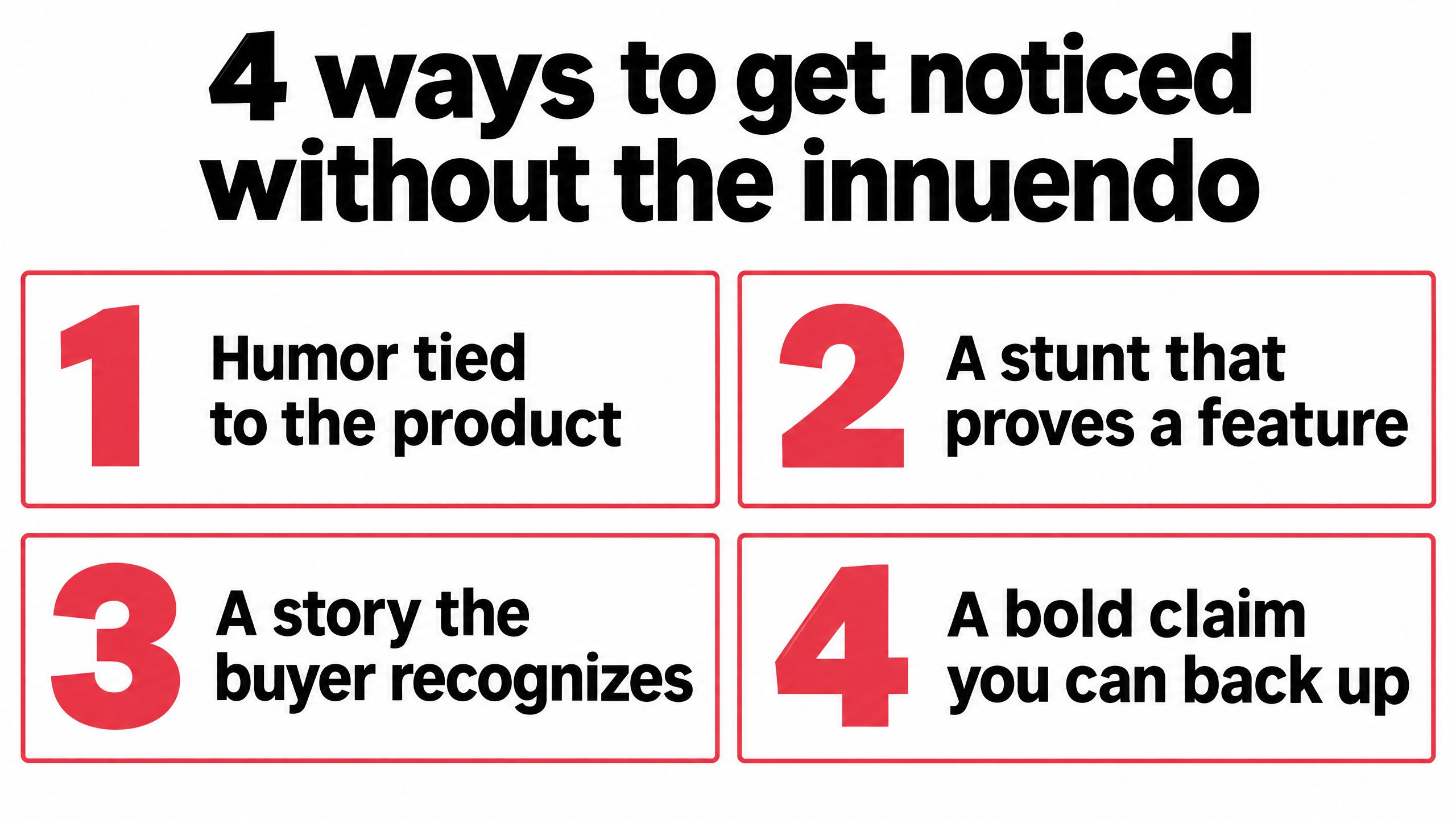
- Humor tied to the product. Dollar Shave Club’s $4,500 launch video was funny, and every joke was about the razors and the price.
- A stunt that proves a feature. Volvo Trucks didn’t explain its steering system with a spec sheet. It showed it with Jean-Claude Van Damme doing the splits between two moving trucks.
- A story the buyer recognizes. Show the frustrating day your customer is having before they find you. If they see themselves, they’ll keep reading.
- A bold claim you can back up. A specific number from a real customer beats a suggestive image every time.
Where to start
As with every campaign, begin with who you are trying to target and what they care about. Use the 4 P’s to get clear on product, price, place and promotion. Then brainstorm ideas around the product itself. Does it resemble anything? Is there a cliché that could be tweaked to point at a real benefit? Is there a moment in your customer’s day that’s funny, painful or surprising?
Attention is easy to buy. Attention that remembers your name and understands why you’re worth it is the hard part. Earn that, and you won’t need the innuendo.
