

Here’s a fun game. Go to the websites of your three biggest competitors and copy the first sentence on each homepage. Now paste them next to yours and remove the company names.
Can you tell which one is you?
If you can’t, your customers definitely can’t. That’s a positioning problem, and it’s one of the most common ones in B2B. Everyone is “innovative,” “customer-focused” and “a trusted partner.” Nobody is anything.
What positioning actually is
Positioning is the place you hold in your customer’s head compared with the alternatives. It answers a simple question a buyer is always asking: “Why you, instead of the other options, including doing nothing?”
A positioning statement is the internal version of that answer. It isn’t a tagline and it doesn’t go on a billboard. It’s the sentence your whole team agrees on, so the website, the sales pitch and the trade show booth all say the same thing.
The classic positioning statement template
The template most marketers use comes from Geoffrey Moore’s book Crossing the Chasm. It goes like this:
For (target customer) who (has this problem or need), our (product) is a (category) that (key benefit). Unlike (main alternative), we (key difference).
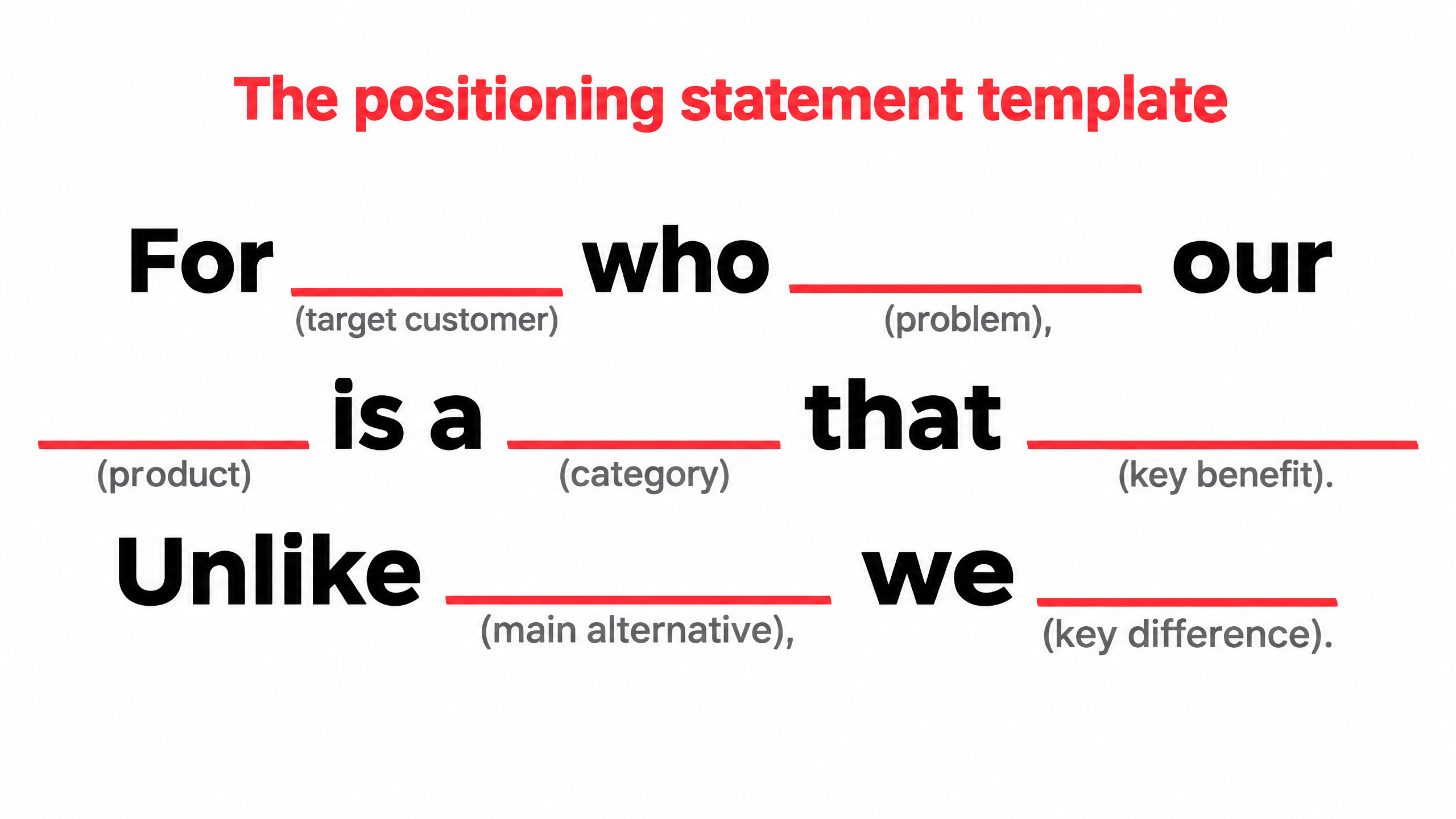
Here’s how that might look for a few made-up B2B companies:
- Fleet software: For owners of 5- to 50-truck fleets who lose hours each week to paperwork, RouteBook is a dispatch app that does the paperwork while the trucks are moving. Unlike enterprise fleet systems, it’s set up in a day and priced per truck.
- Accounting firm: For restaurant groups with three to twenty locations who can’t tell which locations make money, we’re an accounting firm that gives you a profit report per location every Monday. Unlike general bookkeepers, we only work with restaurants.
- Industrial supplier: For maintenance managers at food plants who can’t afford a line going down, we’re a parts supplier that guarantees same-day delivery on 2,000 critical parts. Unlike national distributors, we stock locally and answer the phone ourselves.
Notice what they have in common: a specific customer, a specific problem, and a difference you could actually check. No “innovative.” No “solutions.”
The best positioning ad ever written
In 1962, Avis was the number two car rental company in the US, a long way behind Hertz, and it was losing money. Most companies in that spot would pretend to be number one. Avis’s ad agency, DDB, did the opposite. The campaign said it out loud: “Avis is only No. 2 in rent a cars. So why go with us? We try harder.”
It worked because it turned a weakness into a reason to buy. If you’re number two, you have to fight for every customer: cleaner cars, shorter lines, ashtrays that are actually empty. Customers believed it because it was honest. “We Try Harder” stayed Avis’s slogan for decades.
That’s positioning. Not “we’re the best.” Instead: “here’s exactly where we stand, and here’s why that’s good for you.”
Why most positioning statements fail
They describe the company, not the customer
“We’re a full-service, award-winning agency with 20 years of experience.” Great. What does that do for me? Start with the customer’s problem and work backwards.
They try to appeal to everyone
Good positioning means some people should read it and think “this isn’t for me.” That’s the point. If you’re afraid to exclude anyone, go back and read our post on your ideal customer profile.
They pick the wrong alternative
Your real competitor often isn’t another company. It’s a spreadsheet, an intern, or the buyer deciding to do nothing this year. Position against what customers actually use today.
The difference isn’t real
“Better customer service” isn’t a difference unless you can prove it. “We answer the phone in under a minute, and here’s our average” is.
They’re a logo exercise in disguise
A lot of companies “reposition” by changing their colors and tagline while the product, price and customer stay exactly the same. That’s not positioning. That’s an expensive rebrand.
How to write yours in an afternoon
- List what your best customers would use if you didn’t exist.
- List what you do that those alternatives don’t. Be honest and specific.
- For each difference, write down why a customer would care. (Our features vs. benefits post helps here.)
- Pick the customers who care most about those differences. That’s your target.
- Fill in the template. Then read it to three customers and ask if it sounds like you.
If April Dunford’s book Obviously Awesome is on your shelf, this is a good time to reread it. It’s the best practical guide to B2B positioning there is.
The bottom line
If your positioning could be pasted onto a competitor’s website, it’s not positioning. Be specific about who you’re for, honest about where you stand, and clear about why that matters to the customer. Avis did it with one line. You can too.
