

Ask a business owner who their customer is and there’s a good chance you’ll hear “honestly, anyone could use this.” It sounds generous. It’s actually the most expensive sentence in marketing.
When you market to everyone, you write vague messages, buy broad ads and chase deals that were never going to close. Your sales team spends weeks on prospects who ghost them. Meanwhile, the customers who would love you never hear a message that sounds like it was written for them.
The fix is an ideal customer profile, or ICP. It sounds like jargon, but it’s just a clear description of the customers who get the most value from you and give you the most value back.
ICP vs. buyer persona: what’s the difference?
People mix these up constantly, so quickly:
- Ideal customer profile describes the company: industry, size, location, situation, the problem they have.
- Buyer persona describes the people inside that company: the operations director who feels the pain, the CFO who signs off, the IT manager who can kill the deal.
You need both, but start with the ICP. There’s no point writing a beautiful persona for “Marketing Mary” if Mary works at a company that will never buy from you.
Start with the customers you already have
Your best ICP research is sitting in your invoicing system. Pull a list of your customers and sort them by three things:
- Revenue. Who pays you the most over time?
- Ease. Who was quick to close, easy to onboard and doesn’t email you at 11pm?
- Results. Who gets real, measurable value from what you do (and would say so in a case study)?
The customers that show up near the top of all three lists are your ICP. Now look for what they have in common. Same industry? Similar size? Did they all come to you right after a specific event, like a new hire, a merger or a failed project with a competitor? Patterns will jump out fast.
Equally useful: look at the customers you’d quietly like to fire. The ones who haggled on price, needed endless hand-holding and left after a year. Write down what they have in common too. That’s your “not a fit” list, and it’s just as valuable.
The question Superhuman used to find its best customers
Superhuman, the email app, has a great story about this. Founder Rahul Vohra wanted to know who loved the product most, so he borrowed a survey question from growth marketer Sean Ellis: “How would you feel if you could no longer use Superhuman?” The answers were “very disappointed,” “somewhat disappointed” or “not disappointed.”
The rule of thumb is that if at least 40% of users say “very disappointed,” you’ve found something people really need. When Superhuman first ran it, the number was only 22%. Instead of trying to please everyone, Vohra focused on the people who answered “very disappointed”: who they were, what they loved, and what was holding back the people who were almost there. Within a few quarters the score had climbed to 58%.
You can steal this tomorrow. Send that one question to your customers, then study the “very disappointed” group closely. That’s your ICP talking.
A simple ICP template
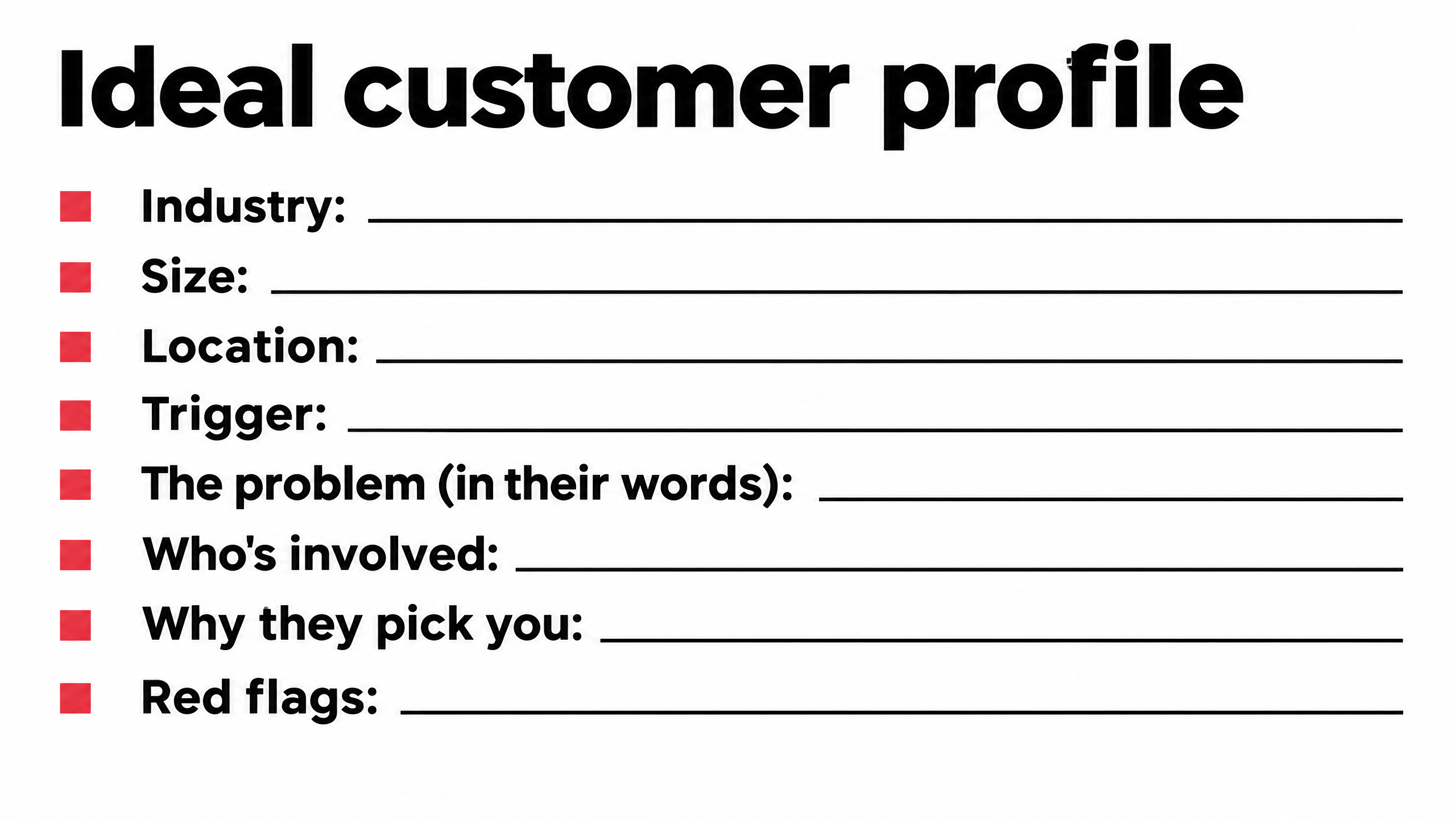
Fill this in for your best-fit customer. Keep it to one page:
- Industry: Be specific. “Manufacturing” is too broad. “Family-owned food manufacturers” is useful.
- Size: Employees or revenue range.
- Location: Where you can actually serve them well.
- Trigger: What happens right before they need you? A new leader, growth spurt, compliance deadline, a bad experience with a competitor?
- The problem in their words: Use real quotes from sales calls or customer interviews.
- Who’s involved: The person with the pain, the person with the budget, and anyone with a veto.
- Why they pick you: The honest reason, according to customers, not the website.
- Red flags: The signs a prospect is going to be a bad fit.
What to do with it
An ICP is only worth something if it changes what you do on Monday:
- Rewrite your website so your ideal customer reads the homepage and thinks “this is for companies like mine.”
- Focus your content on the problems and triggers on your list. (Our one-page marketing plan shows where it fits.)
- Agree on it with sales. Most fights about “bad leads” are really fights about who the customer is. Our post on why sales says your leads are garbage walks through fixing that.
- Say no more often. The hardest and most profitable part. Walk away from deals that hit your red flags.
Revisit it every year
Your ideal customer will change as you grow, launch new services or as the market moves. lululemon learned that the hard way when its customers moved on without it. Put a reminder in your calendar to redo the exercise once a year.
Nobody gives a f* about your logo. But the right customers will care a lot about you, if you take the time to figure out who they are.
