

Ask a small B2B company for its marketing strategy and you’ll usually get one of three answers. “We post on LinkedIn.” “We just redid the website.” Or my favorite: “We’re working on the new logo.”
None of those is a strategy. They’re tactics, and some of them aren’t even good tactics. A strategy is just a clear answer to a few questions: who are we trying to reach, what do we want them to believe, and how are we going to get in front of them often enough that they remember us when it matters?
You don’t need a 60-slide deck for that. You need one page. Here’s how to fill it in.
First, understand the problem: almost nobody is buying right now
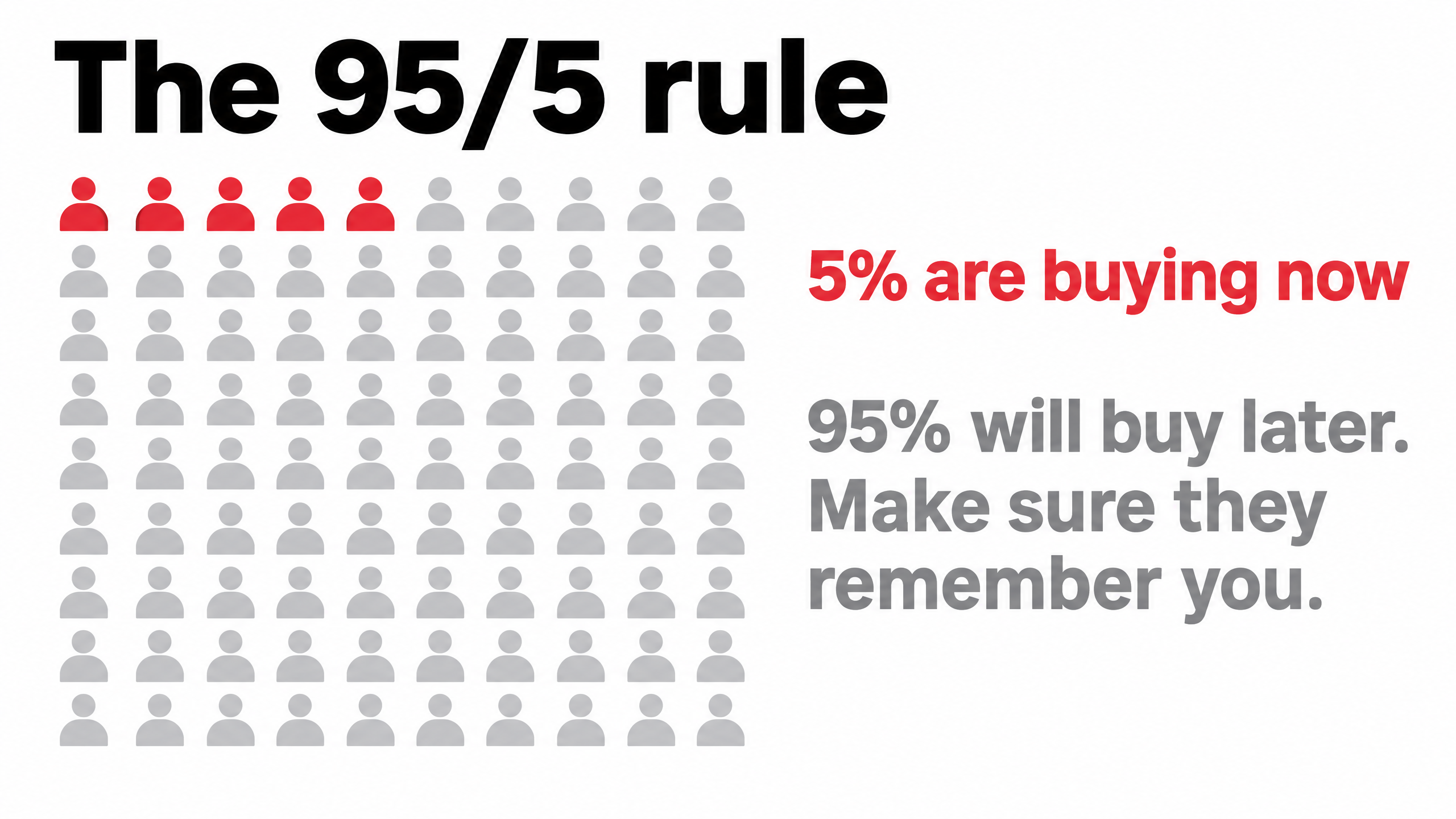
Here’s the single most useful idea in B2B marketing, and most small companies have never heard it. Research from the Ehrenberg-Bass Institute and LinkedIn’s B2B Institute found that at any given moment, only about 5% of your potential buyers are in the market. The other 95% aren’t buying this quarter. Their contract isn’t up, their budget isn’t approved, or the problem hasn’t hurt enough yet.
That changes everything. If you only market to the 5% (ads that say “Book a demo today!”), you’re fighting every competitor for a tiny slice of people. Meanwhile the other 95% will be ready next year, and they’ll call whoever they remember. Your job isn’t just to catch buyers. It’s to be the company they think of first when they’re finally ready.
So your one-page plan has two jobs: get remembered by the 95%, and get chosen by the 5%.
The one-page B2B marketing plan
1. Who exactly are you selling to?
Write down the type of company (industry, size, location) and the job titles of the people who buy and the people who influence the decision. Then write down the problem they have that you solve, in their words, not yours.
If your answer is “any business that needs software,” stop. That’s not a customer, it’s a phone book. Look at your ten best current customers and describe what they have in common. That’s your target. (We’ve got a whole post on figuring out what customers actually care about.)
2. What do you want them to remember?
One sentence. Not your mission statement, not your tagline. The thing you want a buyer to say about you to a colleague: “They’re the ones who do X for companies like us.” If you can’t write it, read our post on how to write a value proposition first.
3. Where do they already spend time?
Pick two or three places, maximum. Industry newsletters, a specific trade association, LinkedIn, a podcast they listen to, Google searches for their problem, or AI chat apps (more and more B2B buyers start there). Small companies fail at marketing by being a little bit present in ten places instead of properly present in two.
4. What will you do for the 95%?
This is the “be remembered” work. It’s slow and it compounds. Examples:
- A useful blog post or video every two weeks answering a question your buyers actually ask.
- A short email newsletter once a month with one genuinely helpful idea.
- Showing up in the same industry group or event every year, not just once.
- The founder or a senior expert posting real opinions on LinkedIn, not “excited to announce” posts.
John Deere has been doing this since 1895 with a magazine for farmers that barely mentions tractors. It works because it’s consistent.
5. What will you do for the 5%?
This is the “get chosen” work. When someone is ready, make it easy:
- A website that says clearly who you help, what it costs (or at least how pricing works) and how to start.
- Two or three strong customer stories with real numbers.
- A fast, human reply when someone gets in touch. Not a 48-hour wait and a bot.
- A clear handoff to sales so good leads don’t die in a spreadsheet.
6. How much will you spend?
Pick a number and split it. A well-known rule of thumb from advertising researchers Les Binet and Peter Field is to put roughly 60% of effort into long-term brand building and 40% into short-term activation, and their later work for B2B suggests something closer to half and half. For a tiny company that might just mean “most of our time goes to content and showing up; some goes to ads when we have a promotion.” Our B2B marketing budget guide has the numbers.
7. How will you know it’s working?
Choose three numbers you’ll check every month. Good ones for small B2B companies:
- New conversations with qualified buyers (not “leads,” actual conversations).
- How people found you (ask every new customer, and write it down).
- Win rate on deals you were invited into.
Website traffic, followers and email open rates are nice to know. They are not the scoreboard.
What to leave off the page
Anything that’s really about you rather than the buyer. The rebrand. The award submission. The 40th version of the homepage hero image. If it doesn’t help a buyer remember you or choose you, it can wait.
The bottom line
A B2B marketing strategy for a small business is not complicated. Know exactly who you serve, give them one thing to remember, show up consistently where they already are, and make it easy to buy when they’re ready. Write it on one page, stick it on the wall, and check it every month.
Your logo isn’t on the list. That’s on purpose.
