

Real estate agents seem to do it best. Their face is front and center and there is just something about their hair, their makeup that automatically translates in our minds… “realtor”. It’s like watching a reality TV show or a soap opera: within milliseconds, you know exactly what type of show it is.
So what is the problem with every owner or president of a company putting their lovely mug, blown up, on every piece of marketing collateral? Well, for one, you ain’t got it kid. Sorry, but we don’t all have a look that captures an audience, but more so it’s because you aren’t selling you, well… unless you are. Real estate agents aren’t created equal. Some are far more detail-oriented, knowledgeable, connected and experienced than others, and that usually equates to more referrals and greater success. They are on every bus stop bench because buying property doesn’t happen very frequently for most people, every eight years on average. Realtors have to stay front-of-mind constantly so their referrals and clients don’t forget about them when it comes time to sell or buy. They are the product and the package and they, if they are good, make a home buyer feel safer about a significant purchase. Trust in that specific person is a huge component of purchasing a home, which is a hugely emotional transaction for most people.
However, when you are selling a product or service, let’s say candles, a customer doesn’t need to trust the owner nearly as much as their realtor. They need to trust the product. Of course, the owner is responsible for making sure the candles are manufactured properly, but you don’t see many reviews about how amazingly the owner manages the company. In product reviews, you read about how amazing it smells or how long the burn time is. No customer gives a sh*t about the owner. They just want a candle that lasts and smells nice, in some opulent glass jar in pretty packaging, that they can give to a friend at a housewarming party and that looks expensive so they don’t look cheap.
So when you are creating an ad campaign and you’re contemplating including someone as the spokesperson and/or a key element of the brand, think twice. Is there a real benefit in it? Is there a story that the target market can relate to? Or is the real reason someone wants their face front-and-center on a marketing piece simply ego driven? I apologize in advance if you have to convince your boss that his face isn’t the best option to promote the product.
Don’t confuse this decision with brand ambassadors and endorsements from the famous. That is an entirely different strategy. Using the identity of someone who is widely known, and who complements your company’s brand, can be a huge win-win to engage quickly with the target market that admires that specific person. Considerations for this strategy mostly surround assurances that the person will stay aligned with your brand. People are people, and if your ambassador makes a public mistake, your company could get cancelled along with them.
When putting the founder up front actually works
To be fair, sometimes it does work. Dave Thomas, the founder of Wendy’s, appeared in hundreds of the chain’s TV commercials from 1989 until his death in 2002. It worked because of what he stood for, not because of his face. He was the plain-spoken guy who cared about a decent hamburger, and he came across as exactly that. He wasn’t saying “look at me.” He was saying “I’d eat this, and so would you.”
That’s the test. The founder works as the message when the founder is the reason to trust the product. A consultant who sells their own expertise. A one-person design studio. A financial advisor whose clients are really buying their judgment. In those cases, the face is the product, just like the realtor.
When it backfires
The danger is that once a company and a person become the same thing, the company inherits everything that person does. Papa John’s is the textbook example. Founder John Schnatter was the face of the pizza chain for decades, right there on the boxes. In 2018, after he used a racial slur on a conference call, he resigned as chairman and the company scrambled to scrub him from its marketing. A company that had spent years saying “this guy is our brand” suddenly had to explain why he wasn’t.
In B2B, the risk is usually less dramatic but just as real. The founder retires. The founder sells. The founder gets into a public fight on LinkedIn. If your whole brand is one person, every one of those becomes a marketing problem.
A quick checklist before you put a face on the ad
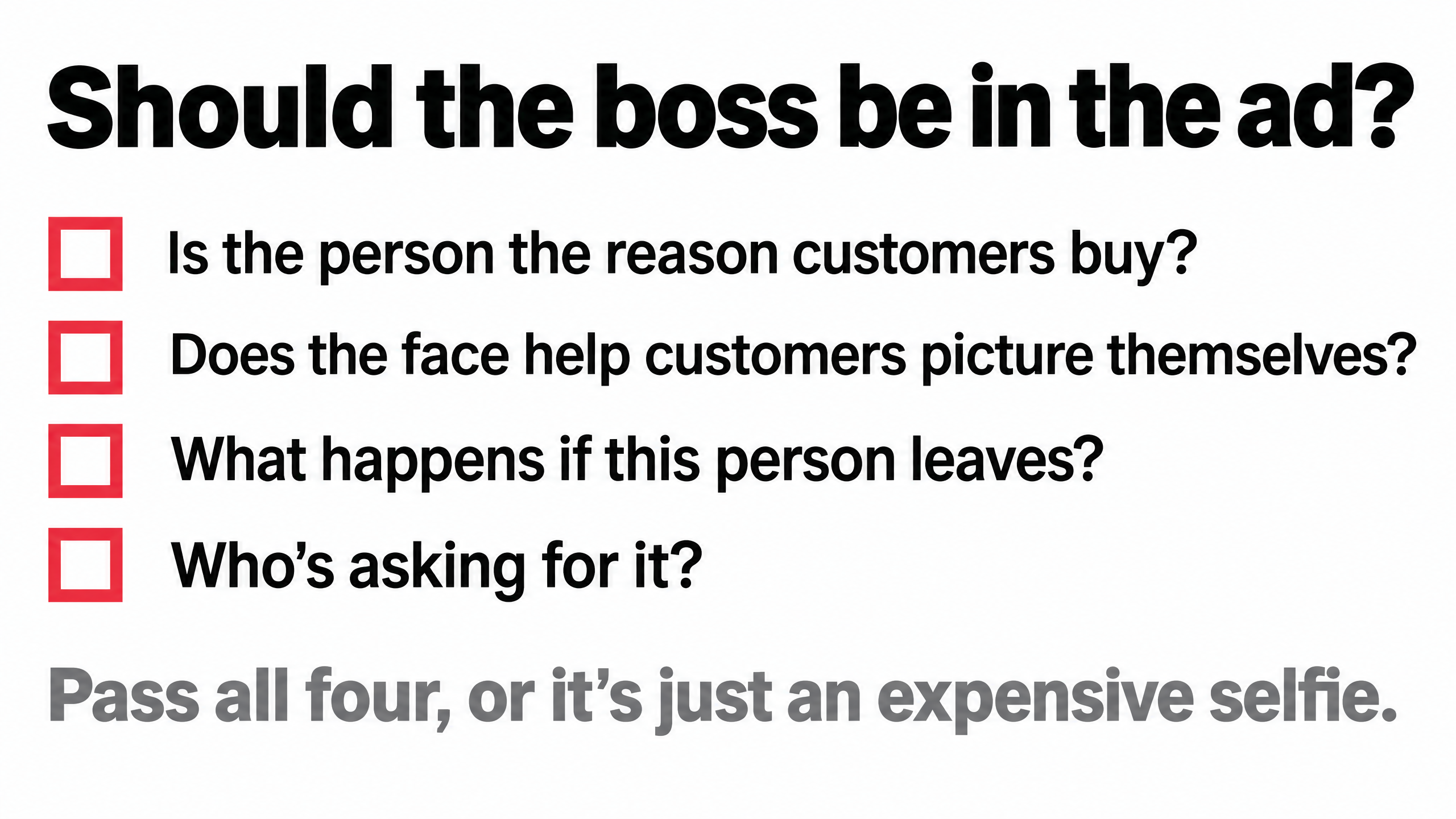
- Is the person the reason customers buy? If customers are buying your product’s results, show the results.
- Does the face help the customer picture themselves? A customer testimonial almost always beats the CEO smiling at the camera.
- What happens if this person leaves? If the answer is “we’d need to redo all our marketing,” think twice.
- Who’s asking for it? If the request came from the person whose face it is, that tells you something.
If you pass all four, go for it. Just don’t call it a strategy if it’s really just a very expensive selfie.
